founded in 1986
NEWS
Giulio Paolini, Giulio Paolini: in due atti - Castello di Rivoli Museo d'Arte Contemporanea
Giulio Paolini, Giulio Paolini: in due atti - Castello di Rivoli Museo d'Arte Contemporanea
29.10.2026 - 28.02.2027
Giulio Paolini
Giulio Paolini: in due atti
Castello di Rivoli Museo d’Arte Contemporanea is pleased to present Giulio Paolini: in due atti, a project by the artist conceived in memory of Gino Viliani.
The exhibition takes place on the second floor of the Castello building, in Room 22, and is curated by Marcella Beccaria and Andrea Viliani.
Developed in two acts, the project brings together eight works from the Viliani Collection, spanning the period from 1962 to 1972. Conceived as an exhibition within an exhibition, the installation reflects on the relationship between the artwork, its author, and the space in which it is presented, fulfilling the collector Gino Viliani’s wish to see his collection displayed in a room conceived and arranged by the artist himself.
Since the beginning of his career Paolini has investigated the conception, appearance, and perception of the work of art. Initially focusing on the constituent elements of painting, his research gradually expanded towards the exhibition as a space of possibilities, questioning the relationship between the artwork and its author. His practice, rooted in conceptual investigation, has developed through a continuous reflection on the nature of artistic representation and the conditions through which an artwork comes into being.
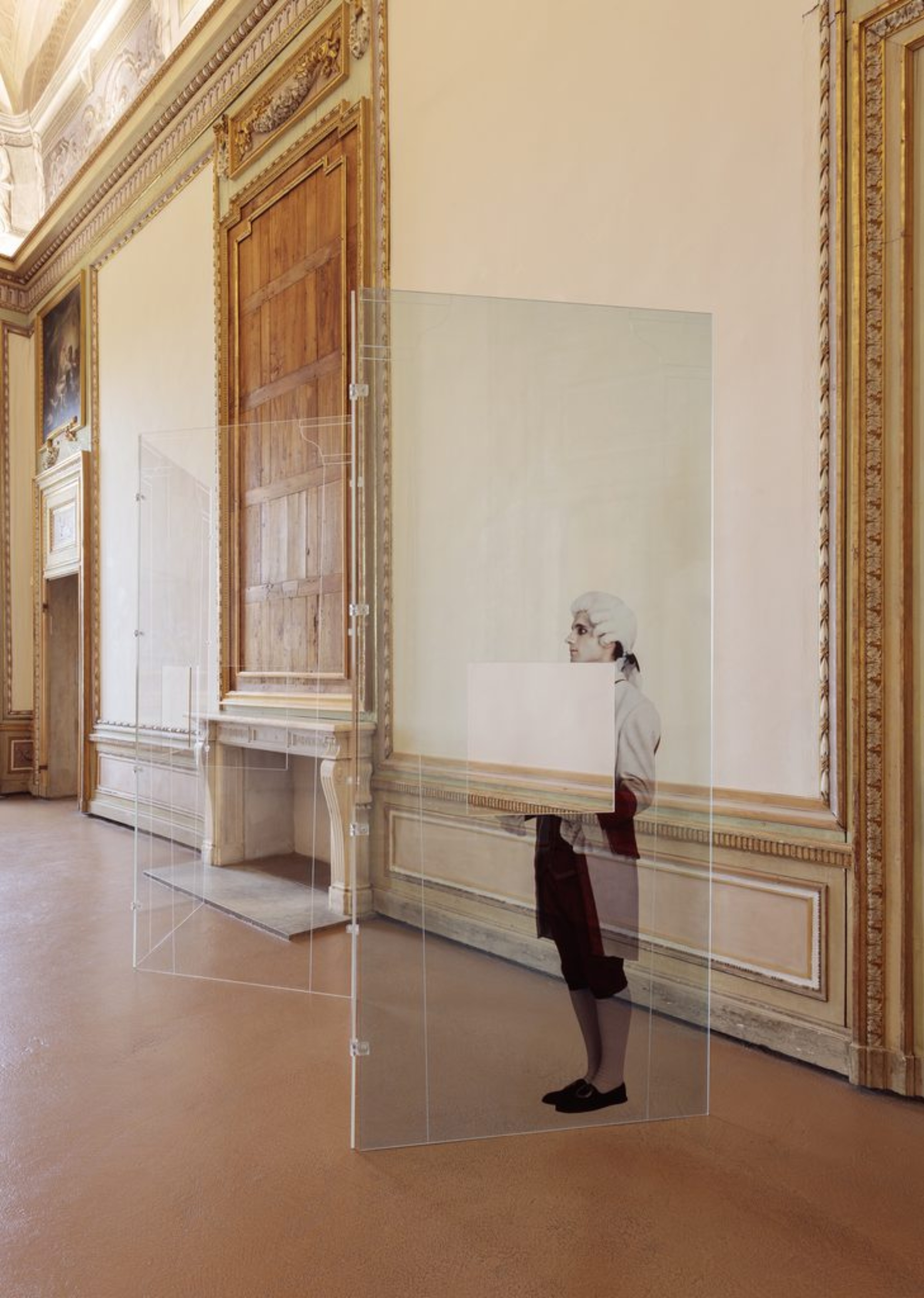
Drawing inspiration from the language of theatre, the project unfolds in two distinct acts. The first, presented from July 2026, brings together elements drawn from two previous installations, Contemplator enim (1992) and In esilio (2012–14): transparent plexiglass curtains engraved with footmen in eighteenth-century attire and a cubic metal structure. These elements establish a suspended setting, anticipating the appearance of the works that will subsequently occupy the space.
From October 29 2026, the second act reveals the eight works from the Viliani Collection, transforming the two installations into structures that accommodate and frame the artworks. Dating from 1962 to 1972, the works document a fundamental decade in Paolini’s artistic development, during which he established the foundations of his research, moving from early conceptual investigations towards the emerging language of Arte Povera. Among them are Senza titolo (1962), Un’offerta speciale (1963), M. Tullio Cicerone (1963), and Una visita alla casa di Raffaello a Urbino (1969), alongside works that explore the relationship between language, image, and the physical structure of the artwork. One of the pieces, Senza titolo (dalla serie dei “Disegni”) (1964), is presented to the public for the first time.
Through this theatrical arrangement, Paolini transforms the museum room into a narrative setting in which different places, figures, and roles converge: the artist’s studio, the domestic interior, the exhibition space, the author, the collector, the curator, and the viewer. The eight works, promised as a gift to Castello di Rivoli and GAM – Galleria Civica d’Arte Moderna e Contemporanea in Turin, also pay tribute to Gino Viliani’s vision as a collector and to his longstanding relationship with both institutions.
Image credits:
Installation view of Act I, Castello di Rivoli Museo d’Arte Contemporanea. Photo: Sebastiano Pellion di Persano.